
Concentrated separation membrane knowledge - microfiltration, ultrafiltration, nanofiltration and reverse osmosis
Published Time:
2025-01-02
A membrane is a material with selective separation capabilities. The process of using membrane selective separation to separate, purify, and concentrate different components of a liquid is called membrane separation. It differs from traditional filtration because membranes can separate at the molecular level, and this process is a physical one that doesn't require phase change or the addition of additives. Membrane pore sizes are typically in the micrometer range. Based on their pore size (also known as molecular weight cutoff), membranes are classified into microfiltration membranes, ultrafiltration membranes, nanofiltration membranes, and reverse osmosis membranes. Based on the material, they can be divided into inorganic membranes and organic membranes. Inorganic membranes are mainly ceramic and metal membranes, which have lower filtration accuracy and selectivity. Organic membranes are made of polymer materials such as cellulose acetate, aromatic polyamide, polyethersulfone, and fluoropolymers. In cross-flow membrane processes, the separation and retention performance of various membranes depends on the pore size and molecular weight cutoff of the membrane. The following diagram briefly illustrates five different membrane separation processes: (The reflected arrow indicates that the substance cannot pass through the membrane and is retained):
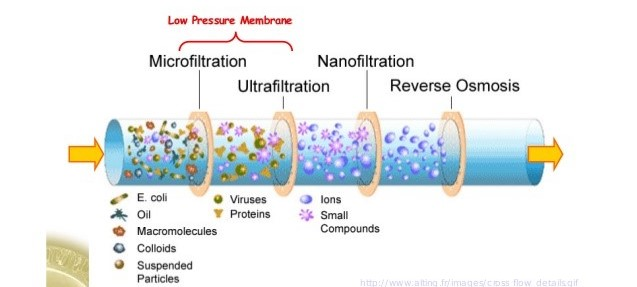
The basic process principle of membrane separation is relatively simple. During filtration, the feed liquid is pressurized by a pump and flows along the membrane surface at a certain flow rate. Substances or molecules with a molecular weight greater than the membrane's molecular weight cutoff do not pass through the membrane and flow back to the feed tank, while those with a molecular weight smaller than the cutoff pass through the membrane to form the permeate. Therefore, the membrane system has two outlets: one for the retentate (concentrated solution) and the other for the permeate. The amount of permeate that flows out per unit time (Hr) and unit membrane area (m2) (L) is called the membrane flux (LMH), which is the filtration rate. Factors affecting membrane flux include temperature, pressure, total dissolved solids (TDS), ion concentration, viscosity, etc. Because the membrane separation process is a purely physical process with characteristics such as no phase change, energy saving, small volume, and separability, membranes are widely used in fermentation, pharmaceuticals, plant extraction, chemical engineering, water treatment processes, and the environmental protection industry. For organic compounds of different compositions, different membranes are selected according to their molecular weight, and appropriate membrane processes are selected to achieve optimal membrane flux and retention rate, thereby improving production yield and reducing investment scale and operating costs.
Microfiltration (MF)
Also known as microporous filtration, it belongs to precision filtration, and its basic principle is a sieving process. Microfiltration membrane materials are divided into two categories: organic and inorganic. Organic polymers include cellulose acetate, polypropylene, polycarbonate, polyamide, etc. Inorganic membrane materials include ceramics and metals. Given the separation characteristics of microporous membranes, their main applications are in intercepting particles, bacteria, and other contaminants in gas and liquid phases to achieve purification, separation, and concentration.
Microporous filtration (MF) is also a low-pressure (typically 10-50 psi) membrane separation technology. Its filtration capacity is only between ordinary filters and ultrafilters, usually only used to separate suspended solids of 0.05 to 10μm. Other dissolved substances in water can pass through the MF membrane. Its screening function is to filter out particles and bacteria in gases or liquids. For microfiltration, the retention characteristics of the membrane are characterized by its pore size, typically in the range of 0.1 to 1 micrometer. Therefore, microfiltration membranes can separate large-diameter bacterial cells, suspended solids, etc. It can be used for clarification, safety filtration of general liquids, and air disinfection.
Ultrafiltration (UF)
It is a membrane process between microfiltration and nanofiltration, with a membrane pore size range of 0.05 um to 1000 molecular weight. Ultrafiltration is a membrane separation technology that can purify, separate, and concentrate solutions. The ultrafiltration process can generally be understood as a sieving process related to the membrane pore size. Using the pressure difference between the two sides of the membrane as the driving force, the ultrafiltration membrane serves as the filtration medium. Under a certain pressure, when water flows over the membrane surface, only water and small molecules with a pore size smaller than the membrane are allowed to pass through, achieving the purpose of purifying, separating, and concentrating the solution.
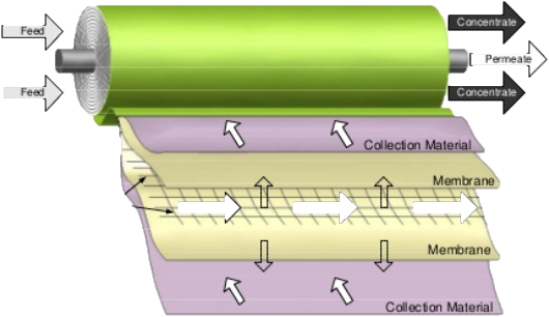
Membrane technology using low-pressure 10-150 psi semi-permeable membranes to separate polymeric substances (molecular weight 1000-300000) is called "ultrafiltration (UF)". Similarly, NF has the characteristics of both RO and UF. This membrane has a high removal rate for divalent ions and ions with a molecular weight greater than 300, while at high concentrations, the removal rate of monovalent ions is only 0-20%. Although the structures of the two are slightly different, and the key objects of their functions are also slightly different, they share the following common characteristics:
It is a low-energy liquid-liquid separation technology.
The process does not require heating or chemical reagents, and the solution quality is not affected.
Different UF and NF membranes with different molecular weight cutoff capabilities can be used to screen different molecular weights. For ultrafiltration, the retention characteristics of the membrane are characterized by the molecular weight cutoff of standard organic compounds, typically between 1000 and 300000. Therefore, ultrafiltration membranes can separate large molecular weight organic compounds (such as proteins, bacteria), colloids, suspended solids, etc., and are widely used in the clarification of feed solutions, the separation and purification of large molecular weight organic substances, and heat removal.
Nanofiltration (NF)
For nanofiltration, the retention characteristics of the membrane are characterized by the retention rate of standard NaCl, MgSO4, and CaCl2 solutions. The typical retention rate range is 60%-90%, and the corresponding molecular weight range is 100-1000. Therefore, nanofiltration membranes can separate small molecular weight organic compounds from water and inorganic salts, achieving simultaneous desalination and concentration.
Reverse Osmosis (RO)
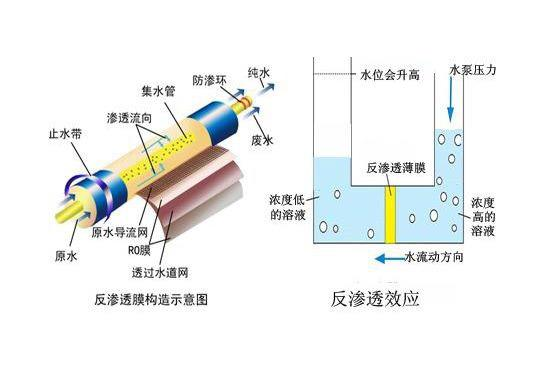
When two concentrated solutions of different concentrations are separated by a semi-permeable membrane, according to natural phenomena, the solution with lower concentration will permeate to the side with higher concentration. The permeation of pure water into salt water is a typical example. However, if sufficient pressure (i.e., greater than the osmotic pressure) is applied to the saltwater side, an abnormal phenomenon of saltwater permeating into pure water will occur, which is called "reverse osmosis (RO)". The characteristics of this technology are:
The retention object of reverse osmosis is all ions, only allowing water to pass through the membrane. The retention rate of NaCl is over 98%, and the effluent is ion-free water. Reverse osmosis can remove soluble metal salts, organic matter, bacteria, colloidal particles, and pyrogens, meaning it can intercept all ions. Reverse osmosis membranes have been widely used in the production of purified water, softened water, deionized water, product concentration, and wastewater treatment.
Maximum operating temperature of filter membranes made from different materials
EPJPUSP Pharmacopoeia requirements for purified water
Related News
The Essential Guide to Understanding Filter Cartridges in Industrial Applications
In the realm of industrial equipment, filter cartridges play a crucial role in maintaining operational efficiency and ensuring product quality. These components are designed to trap contaminants, preventing them from entering machinery and processes. Understanding the types, applications, and maintenance of filter cartridges is essential for professionals looking to optimize filtration systems. Fi
Choosing Between Single-use and Reusable Microporous Filter Cartridges: A Comprehensive Guide
Choosing Between Single-use and Reusable Microporous Filter Cartridges: A Comprehensive Guide Table of Contents Introduction Understanding Microporous Filter Cartridges Single-use Filter Cartridges Advantages of Single-use Filter Cartridges Disadvantages of Single-use Filter Cartridges Reusable Filter Cartridges Advant
Understanding Depth Filters: A Comprehensive Guide for Industry Professionals
Depth filters play a crucial role in various industrial applications, particularly in the filtration of liquids and gases. Unlike surface filters, which capture contaminants on the surface, depth filters are designed to trap particles throughout their thickness, allowing for a more efficient filtration process. This unique characteristic makes them particularly effective for removing larger volume
Key Differences Between Membrane and Depth Syringe Filters Explained: A Comprehensive Guide
Key Differences Between Membrane and Depth Syringe Filters Explained Understanding the Basics of Filtration Filtration is a crucial process in various industries, including pharmaceuticals, biotechnology, and food processing. The choice of filter type significantly impacts the quality and efficiency of filtration processes. Among the many filtration options available, membrane and depth syringe fi
Understanding SS Filter Cartridges: Essential Insights for Industrial Filtration
SS filter cartridges, or stainless steel filter cartridges, play a crucial role in various industrial applications where effective filtration is necessary. These cartridges are designed to remove impurities from fluids and gases, ensuring the quality and reliability of processes in industries such as food and beverage, pharmaceuticals, chemicals, and water treatment. One of the primary advantages
Stainless Steel Filters: The Ultimate Investment for Your Industrial Filtration Solutions
Stainless Steel Filters: An Investment in Your Industrial Filtration Needs Introduction to Industrial Filtration and the Importance of Filters In the realm of industrial processes, filtration plays a critical role in maintaining the purity and quality of liquids and gases. Stainless steel filters stand out as one of the most effective solutions for achieving high levels of filtration efficiency. T

Cooperate with us immediately
We focus on filtering the market, with a strict quality system and professional management model, stably producing high-quality filtering products, allowing our customers to filter with peace of mind. If you have any questions, please leave a message to consult!
Manager Geng
Manager Hu
© Copyright - 2025 Hangzhou Hexin Technology Co., Ltd.
浙公网安备33010602014027号
WhatsApp:8613858564135
WhatsApp:8619564072084
Email:service@hz-hx.cn
Email:valisanatalia373@gmail.com
Email:seller@hz-hx.cn