
Instruction Manual for "HeXin" Microporous Membrane Bacterial Filter
Published Time:
2024-09-09
I. Product Introduction:
"Hexin" brand filter membrane cartridges and filters are currently popular microporous filtration equipment internationally. They are equipped with composite folded microporous membrane filter cartridges, achieving a certain particle filtration effect through microporous screening on the membrane surface. They have advantages such as high filtration precision, good filtrate quality, small filter volume, large flow rate, simple operation, and low production cost. The main materials meet the biosecurity requirements of the sixth level of the 22nd edition of the United States Pharmacopeia and comply with Chinese standards GB9688-88 and GB/T-17219-1998.
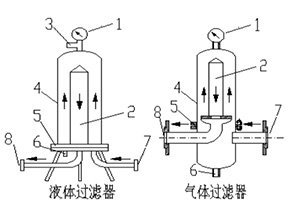
II. Filter Installation Diagram:
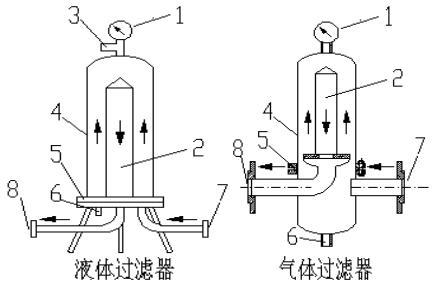
1. Pressure Gauge
2. Filter Cartridge
3. Vent Valve
4. Cylinder
5. Flange, Gasket
6. Drain Port
7. Gas/Liquid Inlet
8. Gas/Liquid Outlet
III. Installation and Usage Notes:
1. Before using the stainless steel filter, check that the accessories and sealing rings are complete and intact. New filter cartridges are packaged in plastic bags in a clean production facility; do not tear the plastic packaging before use. The integrity of high-precision filter cartridges such as HPS and HPF is checked using a bubble point test.
2. New filters must be thoroughly cleaned with a detergent (please do not use acids for cleaning). After cleaning, sterilize and disinfect with high-temperature steam. The inlet and outlet of the cleaned filter should be sealed to avoid contamination.
3. Then, refer to the installation diagram and connect according to the requirements. When installing the filter, the inlet and outlet cannot be reversed; the general principle is outside-in (referring to the filter cartridge).
4. When inserting the filter cartridge into the interface, first moisten the sealing ring with sterile water or filtered liquid to reduce friction resistance during insertion, and keep it vertical during insertion. After inserting the 222 filter cartridge, use the pressure plate to hold the tip fins and tighten the screws without moving; after inserting the 226 interface filter cartridge, rotate it 90 degrees to lock it, ensuring a seal and no leakage to meet the usage requirements.
5. When disassembling and assembling the titanium rod filter cartridge, avoid contaminating the housing, and avoid excessive force or collision with hard objects (do not use metal pliers, wrenches, etc.) to prevent breakage of the housing due to improper force.
6. After installation, online clean steam sterilization and disinfection can be used.
7. When filtering liquid enters, first loosen and open the vent valve (3) switch at the top of the filter, and allow the liquid to fill the filter before promptly tightening and closing it to ensure filtration effectiveness.
8. The pressure gauge at the top of the cylinder is a liquid pressure indicator. As the usage time increases, the pressure difference gradually increases, and the flow rate gradually decreases, indicating that the pores of the filter cartridge are gradually being blocked. Cleaning or replacement of the filter cartridge is required at a certain point.
9. During filtration, the pressure used is generally around 0.1-0.2 MPa, as needed. As time and flow rate increase, the micropores of the filter cartridge will become blocked, and the pressure will increase. Generally, it should not exceed 0.25 MPa; gas filtration should not exceed 1.0 MPa. Otherwise, it may puncture the filter cartridge, damage the filter, or even cause accidents. If it is necessary to exceed the above pressure, special processing can be arranged.
10. For backwashing the filter cartridge, sterile water must be used to avoid contaminating the filter cartridge. Backwashing method: The original outlet becomes the inlet, and sterile water is sent in the reverse direction (be sure to close the material liquid filtration pipeline), open the drain port, and continue until the effluent shows significant improvement.
11. When the filter is not in use, open the drain port (6) and drain as much liquid as possible. The filtrate should not be stored overnight. If the shutdown time is within eight hours, it is generally not necessary to open the filter or remove the filter cartridge. If the shutdown time is more than 24 hours, the filter cartridge and filter should be cleaned (the backwashing method can also be used) to prevent material and filter cartridge hardening, blockage, mildew, and bacterial contamination.
12. The optimal operating temperature of the filter cartridge is 25℃-50℃. The long-term operating temperature should be controlled at around 60℃, and the sterilization temperature is 121℃ for 30 minutes. If the operating temperature is higher, a stainless steel reinforced filter cartridge or a high-temperature resistant filter cartridge made of stainless steel or titanium alloy can be selected.
13. When filtering organic solvents and high-concentration chemicals, please refer to the "Chemical Compatibility" classification table in the filter cartridge usage instructions in our company's product catalog, or contact us to use special filter cartridges to solve the problem.
14. For self-selected matching use, please pay attention to the required flow rate and pressure. The transfer pump should use a hygienic vortex pump or infusion pump, with matching lift and materials 304, 316L, and mechanical end-face seals.
IV. Maintenance Methods:
1. If not used for a long time, the filter must be thoroughly cleaned, the filter cartridge removed, washed, and dried, sealed in a clean plastic bag, and stored in a cool, dry place.
2. The replaced filter cartridges can be soaked in a 75% medical ethanol solution. If soaked in acid-base washing solution, the room temperature soaking time is generally 24 hours, with an acid-base PH of 3-9. For filtrates with high protein content, the filter cartridges are best soaked in an enzyme solution. After soaking, they should be cleaned in sequence with clean water until clean. Steam sterilization is required before reuse.
3. Pay attention to controlling the time and temperature of filter cartridge sterilization; generally, 121℃ for 30 minutes is appropriate.
4. Check the tightness of the sealing rings and the condition of the gaskets, and replace them in time.
5. Regularly wipe the cylinder to keep the surface clean and bright.
V. Marking, Packaging, Transportation, and Storage
1. Each filter should have a permanent nameplate fixed in a conspicuous location, indicating the installation direction. The nameplate should comply with the provisions of GB/T13306 and indicate:
a. Product Name b. Product Model and Specifications c. Product Weight
d. Factory Number e. Manufacturing Date and Manufacturer Name
2. Filters should be stored in a warehouse with rain protection, and during storage and transportation, a clear indication should be provided that they must not be inverted.
3. Each filter should be accompanied by the following documents upon leaving the factory:
a. Packing list b. Product manual c. Pressure test report
d. Product qualification certificate
New Product Release
Rapid wetting method for hydrophilic filter cartridges
Related News
The Essential Guide to Understanding Filter Cartridges in Industrial Applications
In the realm of industrial equipment, filter cartridges play a crucial role in maintaining operational efficiency and ensuring product quality. These components are designed to trap contaminants, preventing them from entering machinery and processes. Understanding the types, applications, and maintenance of filter cartridges is essential for professionals looking to optimize filtration systems. Fi
Choosing Between Single-use and Reusable Microporous Filter Cartridges: A Comprehensive Guide
Choosing Between Single-use and Reusable Microporous Filter Cartridges: A Comprehensive Guide Table of Contents Introduction Understanding Microporous Filter Cartridges Single-use Filter Cartridges Advantages of Single-use Filter Cartridges Disadvantages of Single-use Filter Cartridges Reusable Filter Cartridges Advant
Understanding Depth Filters: A Comprehensive Guide for Industry Professionals
Depth filters play a crucial role in various industrial applications, particularly in the filtration of liquids and gases. Unlike surface filters, which capture contaminants on the surface, depth filters are designed to trap particles throughout their thickness, allowing for a more efficient filtration process. This unique characteristic makes them particularly effective for removing larger volume
Key Differences Between Membrane and Depth Syringe Filters Explained: A Comprehensive Guide
Key Differences Between Membrane and Depth Syringe Filters Explained Understanding the Basics of Filtration Filtration is a crucial process in various industries, including pharmaceuticals, biotechnology, and food processing. The choice of filter type significantly impacts the quality and efficiency of filtration processes. Among the many filtration options available, membrane and depth syringe fi
Understanding SS Filter Cartridges: Essential Insights for Industrial Filtration
SS filter cartridges, or stainless steel filter cartridges, play a crucial role in various industrial applications where effective filtration is necessary. These cartridges are designed to remove impurities from fluids and gases, ensuring the quality and reliability of processes in industries such as food and beverage, pharmaceuticals, chemicals, and water treatment. One of the primary advantages
Stainless Steel Filters: The Ultimate Investment for Your Industrial Filtration Solutions
Stainless Steel Filters: An Investment in Your Industrial Filtration Needs Introduction to Industrial Filtration and the Importance of Filters In the realm of industrial processes, filtration plays a critical role in maintaining the purity and quality of liquids and gases. Stainless steel filters stand out as one of the most effective solutions for achieving high levels of filtration efficiency. T

Cooperate with us immediately
We focus on filtering the market, with a strict quality system and professional management model, stably producing high-quality filtering products, allowing our customers to filter with peace of mind. If you have any questions, please leave a message to consult!
Manager Geng
Manager Hu
© Copyright - 2025 Hangzhou Hexin Technology Co., Ltd.
浙公网安备33010602014027号
WhatsApp:8613858564135
WhatsApp:8619564072084
Email:service@hz-hx.cn
Email:valisanatalia373@gmail.com
Email:seller@hz-hx.cn