Home
About
Products
Solution
Food and Beverage
Beer Filtration Application
Water Filtration
Wine filtration
Life Sciences
Plasma Separation and Filtration
Eye Drop Filtration Scheme
Small Volume Injection(SVP)
Large Volume Injection Process (LVP)
Culture Medium
Water Treatment
Public System Water Use
Technology
Technical Service
Download Materials
Blog
Company News
Industry News
Project Dynamics
Contact Us
Language
中文
English
Russian
News Information
knowledge
2025-01-02
Concentrated separation membrane knowledge - microfiltration, ultrafiltration, nanofiltration and reverse osmosis
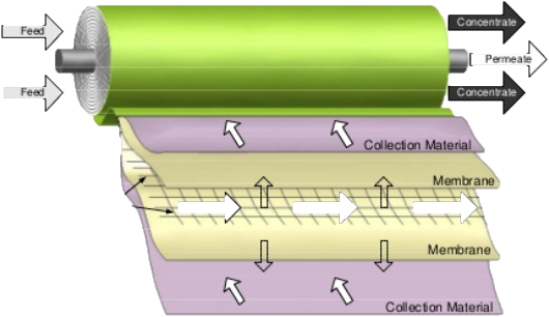
A membrane is a material with selective separation function. The process of using membrane selective separation to separate, purify, and concentrate different components of a liquid is called membrane separation. It differs from traditional filtration because membranes can separate at the molecular level, and this process is a physical process that does not require phase change or the addition of additives. The pore size of the membrane is usually in the micrometer range. According to its pore size (also known as molecular weight cut-off), membranes can be divided into microfiltration membranes, ultrafiltration membranes, nanofiltration membranes, and reverse osmosis membranes. According to the material, they can be divided into inorganic membranes and organic membranes. Inorganic membranes are mainly ceramic membranes and metal membranes, which have lower filtration accuracy and selectivity. Organic membranes are made of polymer materials such as cellulose acetate, aromatic polyamide, polyethersulfone, and polyfluoropolymers. In cross-flow membrane processes, the separation and retention performance of various membranes depends on the pore size and molecular weight cut-off of the membrane. The following figure briefly illustrates five different membrane separation processes: (The reflected arrow indicates that the substance cannot pass through the membrane and is retained):
EPJPUSP Pharmacopoeia requirements for purified water
Water quality design
Pore size is expressed in Daltons, micrometers, nanometers, and angstroms
KD is an abbreviation for kilodalton, equal to a molecular weight cutoff (MWCO) of 1000. A solution with a molecular weight of 1,000,000 is equivalent to 1000 KD.
Type and working range of filter membranes
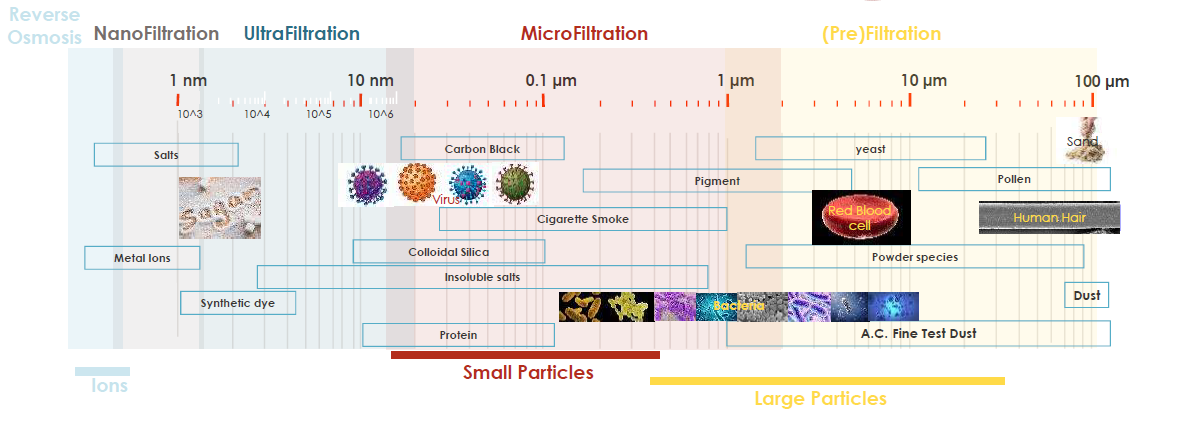
Filter membranes used to remove pollutants from water may vary depending on the size and type of the target contaminants (as shown in the figure below). In order of pore size, membrane applications can be classified as microfiltration membranes, ultrafiltration membranes, reverse osmosis membranes, etc., used for bacteria, microorganisms, proteins, and suspended solids respectively.
2024-09-09
Instruction Manual for "HeXin" Microporous Membrane Bacterial Filter
“Hexin” membranes and filters are currently popular microporous filtration devices internationally. They are equipped with composite folded microporous membrane filter cartridges, which achieve a certain particle filtration effect through microporous screening on the membrane surface. They have advantages such as high filtration precision, good filtrate quality, small filter volume, large flow rate, simple operation, and low production cost. The main materials meet the biosecurity requirements of Grade 6 in the 22nd edition of the United States Pharmacopeia and comply with Chinese standards GB9688-88 and GB/T-17219-1998.
2024-12-23
Rapid wetting method for hydrophilic filter cartridges
Install the new filter cartridge into the filter housing and fill it with pure water.